Learning at Work Week and Laughter: What the Science Says | Learning at Work Week

By Sunny Turner
Learning at Work Week and Laughter: What the Science Says
What Your Brain Actually Needs to Learn – and Why Laughter Is Part of the Answer
Learning at Work Week 2026 takes place 18-24 May, and this year’s theme is “Many Ways to Learn.” It’s an invitation to think broadly about how people actually develop skills and grow – not just what courses are on offer, but whether the right conditions exist for learning to happen at all.
Because the content of your L&D programme is only half the story.
The other half is the state your people are in when they walk into the room. Whether that’s a course, a workshop, a conference, a webinar, or simply sitting down with a book – the internal conditions matter just as much as the content itself.
When Stress Gets in the Way
Most organisations know that stress affects performance. Fewer stop to think about what it does to learning specifically.
When someone is carrying a high stress load – stretched beyond capacity by workload, or simply weighed down by a difficult few weeks – their brain shifts into a kind of protective mode. Cortisol rises, focus narrows, and the part of the brain responsible for forming new memories and thinking creatively becomes much harder to access. People in that state aren’t disengaged. They’re just not in a position to take much in.
You can have the best facilitator in the world, the most relevant content, and an engaged group – and still find that very little of it sticks, because the nervous system was working against you from the start.
This isn’t a motivation problem. It’s biology. And it’s one of the most consistently overlooked barriers to effective workplace learning.
What Laughter Actually Does to the Brain
Laughter – deep, sustained, physical laughter – does something remarkable to the body. Cortisol drops. Breathing deepens. And laughter activates the brain’s dopamine reward system, which plays a direct role in both motivation and long-term memory.
Interesting, isn’t it?
Laughter activates the hippocampus – the brain’s memory centre – and the dopamine it releases enhances synaptic plasticity: the brain’s ability to physically form new neural connections. Chronic stress does the opposite – it actively suppresses neuroplasticity. So when a team arrives at a training day under heavy stress, they’re not just uncomfortable. Their brain’s capacity to build new pathways is reduced. Laughter addresses both sides of that – clearing the stress response and creating the neurological conditions where new learning can actually take root.
There’s something else worth noting, too. When people laugh together, they become more open. More willing to be a little vulnerable. Less guarded about looking like they don’t know something or getting something wrong. That humility – the willingness to try, to be imperfect, to not take yourself too seriously – is one of the foundational conditions for learning.
What I’ve Seen in the Room
As we head into Learning at Work Week, working with corporate teams recently, I’ve seen the science play out in a way that’s impossible to ignore.
Working with corporate teams recently, I’ve seen the science play out in a way that’s impossible to ignore.
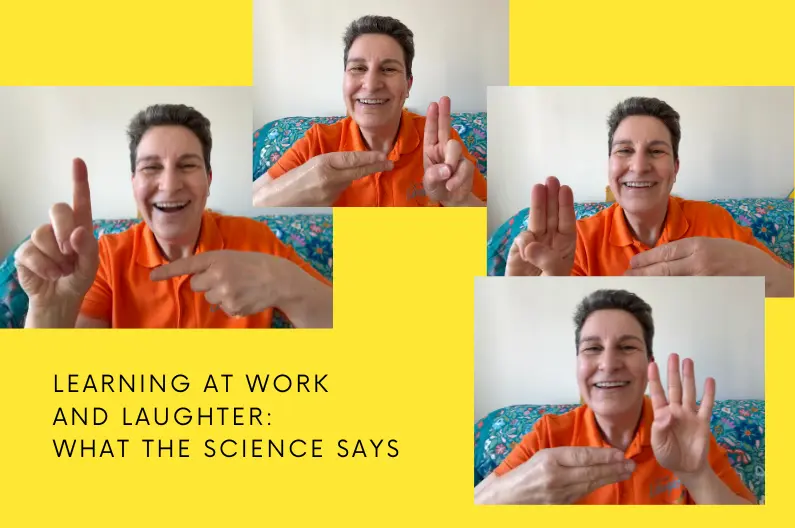
When I introduce bilateral stimulation exercises – cross-lateral movements that ask both sides of the body to coordinate – stressed participants visibly struggle with them. Not because of fitness or ability, but because high cortisol disrupts the brain’s left-right integration. These exercises rely on both hemispheres communicating through the corpus callosum, and stress interferes with that process. It’s one of the most visible signs of what stress does to a team’s capacity to learn – stress made visible, in real time, through movement.
As the laughter builds and the stress response settles, those same exercises become noticeably easier. The brain starts working as a whole again. And that matters, because bilateral stimulation supports the building of new neural connections – the same pathways that better learning depends on. Laughter and bilateral movement work in the same direction, and watching it happen with a group of colleagues is one of the most compelling things I get to witness as a facilitator.
Interestingly, many seniors I’ve worked with recently have had greater success with these exercises – possibly because they tend to carry less of the acute deadline-driven stress that shows up so visibly in corporate groups.

Laughter Yoga: Not What You’d Expect
Laughter Yoga – developed by Dr Madan Kataria in 1995 – doesn’t wait for something funny to happen. It uses simulated laughter exercises combined with breathing techniques to trigger the same physiological and psychological response as spontaneous laughter. No jokes required. No need to perform or be witty. It uses breathing, movement, and laughter that starts as simulated and very quickly becomes real.
And that willingness to show up and have a go is, in itself, a learning mindset.
Every Learning at Work Week, I’m reminded of the same pattern when I work with corporate teams. People arrive with arms crossed and polite scepticism on their faces. Within minutes, the laughter starts – simulated, then spontaneous – and the room transforms. Shoulders drop. Eyes soften. People look at their colleagues differently. That shift – from guarded to open, from tense to connected – creates exactly the kind of trust and psychological safety that makes teams learn better together.
I feel so strongly about this that it’s shaped how I work personally, too. When I’m about to spend a full day on a hard task, I always laugh first to switch my brain on and bring my stress levels down. It’s also why I host focus sessions on flown.com that start with ten minutes of laughter exercises – because the difference it makes to what follows is something I’ve experienced myself, every time.
Here’s what some participants from those sessions have said:
“I have been able to focus and work! And loved starting with positive energy. I have to finish a report I do not enjoy writing at all, and it was great to start it with a laugh.”
“Thank you so much, that was amazing.”
“I feel like I was carried by a wave of energy.”
Where It Fits This Year’s Theme
Learning at Work Week 2026 sits across three strands – Learn to Learn, Learn for Life, and Learn for Work – and Laughter Yoga touches all three.
Learn to Learn is about building a growth mindset and the capacity to engage with learning. A Laughter Yoga session asks people to step outside their comfort zone in a low-stakes, supported way. It builds the very qualities that make someone a better learner – openness, willingness to try, and trust in the group around them.
Learn for Life focuses on resilience, confidence, and well-being. Laughter Yoga is an evidence-based wellbeing practice. Participants regularly report better sleep, lower anxiety, more energy, and a more positive outlook. These aren’t side effects – they’re what make sustained, lifelong learning possible.
Learn for Work is about practical skills and performance. A team that feels psychologically safe and connected learns faster, collaborates more effectively, and adapts more readily to change. A Laughter Yoga session before a training day, a workshop, or a team away-day shifts the atmosphere in a room – and that shift matters.
Before the Learning Starts
There’s an old idea that learning has to look a certain way. A course, a module, a presenter, a workbook. But the research on experiential and social learning tells a different story.
We learn by doing. By feeling safe enough to try. By laughing at ourselves when something goes sideways and then trying again. Laughter Yoga creates all of those conditions at once – quickly, with very little setup and a lot of energy.
Learning at Work Week is the perfect moment to ask whether your organisation is creating the right conditions for learning – not just the right content. A Laughter Yoga session is worth considering.
Not because it’s a fun warm-up. Because it works.
Our Serious Wellbeing Team deliver evidence-based, accessible laughter sessions to make life and work happier and healthier. Teams thrive with the right wellbeing tools. Get in touch at happy@seriouslaughter.co.uk
Want to see what a Serious Laughter session could look like for your team? Take a look at our services pack here: https://drive.google.com/file/d/1mib-5GnqUitsY21S9U1K2YGluXRcEVqV/view?usp=sharing
Find out more about co-working online with a wellbeing twist at flown.com
Sunny Turner | Founder, Serious Laughter | FHT-Accredited Laughter Yoga Teacher | Museum of Happiness Facilitator | Comedy on Prescription Certified Facilitator

Sign Up
Receive wellness tips & uplifting videos from Serious Laughter.