What Workplace Stress Really Does to Your Body

By Sunny Turner
What Workplace Stress Really Does to Your Body – And How Laughter Helps
Most organisations acknowledge that stress is a problem. Far fewer understand what it is actually doing to their people – physically, beneath the surface, day after day.
April is Stress Awareness Month, and this year I want to go a little deeper than the usual tips. Because when you understand what workplace stress is genuinely doing to the body, the case for taking it seriously – and for doing something about it – becomes very clear.
It is widely reported – including by the American Institute of Stress – that up to 90% of all illnesses are stress-related. Whether that precise figure holds up in every context, the broader point is hard to argue with: stress is not a separate issue from physical health. For your employees, it sits at the root of a great deal of sickness absence, reduced performance, and burnout.

Your Body Was Built for Short Bursts of Stress
Stress itself isn’t the enemy. The stress response – often called fight or flight – is a survival mechanism. When the brain senses a threat, it triggers a cascade of physical changes: heart rate rises, muscles tense, breathing speeds up, and cortisol and adrenaline flood the system.
This is brilliant if you need to run from danger. The problem is that the nervous system doesn’t always distinguish between a physical threat and a difficult conversation with a manager, a mounting workload, or the relentless pressure to be always available. It responds to all of it in the same way.
And when that stress response is activated repeatedly – across a working week, month after month – the cumulative effect on the body is significant.
The Physical Effects of Chronic Stress
Here is what the research tells us about what ongoing workplace stress can do to the body:
- Heart health – Chronic stress is linked to raised blood pressure, increased heart rate, and a higher risk of cardiovascular disease. The repeated release of adrenaline and cortisol puts sustained pressure on the heart and blood vessels. This is one of the most serious long-term consequences of a high-pressure working environment.
- The immune system – Elevated cortisol suppresses immune function over time. The body produces fewer natural killer cells – the white blood cells responsible for identifying and destroying viruses and abnormal cells – and antibody levels fall. This is why employees under sustained pressure are significantly more prone to colds, infections, and slow recovery. Research from Loma Linda University has shown that laughter actively reverses this, increasing natural killer cell activity and raising immunoglobulin A levels – the antibody that defends against respiratory infections.
- Digestion – The gut and the brain are deeply connected. Stress diverts blood away from the digestive system, leading to symptoms including nausea, bloating, constipation, or irritable bowel. Many employees notice their appetite changes significantly during periods of high workload.
- Muscle tension and pain – The body braces under stress. Persistent muscle tension – particularly in the neck, shoulders, and back – is one of the most common physical complaints linked to prolonged workplace pressure, and a leading cause of sickness absence.
- Sleep – Cortisol is a wakeful hormone. When levels remain elevated into the evening, it interferes with the body’s ability to wind down – making it harder to fall asleep and stay asleep. Poor sleep then creates more stress, and the cycle continues. Employees arrive at work already depleted.
- Hormones and reproduction – Chronic stress can disrupt the hormonal system more broadly, affecting menstrual cycles, libido, and fertility. The body, when under sustained threat, deprioritises reproduction as part of its survival response.
This is not an exhaustive list. Stress touches almost every system in the body – and its effects are cumulative. For HR professionals and leaders, the picture is stark: when stress goes unaddressed, it doesn’t stay neatly inside working hours. It follows people home, disrupts their sleep, weakens their immune system, and eventually shows up in your absence data.
The Cortisol Connection
Cortisol is the hormone most closely associated with stress, and understanding its role is worth it. In short bursts, cortisol is useful – it sharpens focus and provides energy. But when cortisol remains elevated for a long time, it acts like a slow drip of harm throughout the body.
A meta-analysis published in Psychoneuroendocrinology found that Laughter Yoga may act as a buffer against the endocrine stress response, potentially helping reduce cortisol levels. This is not a small finding. If we can find simple, accessible ways to lower cortisol naturally, we may be able to protect the body from some of the longer-term effects of stress.
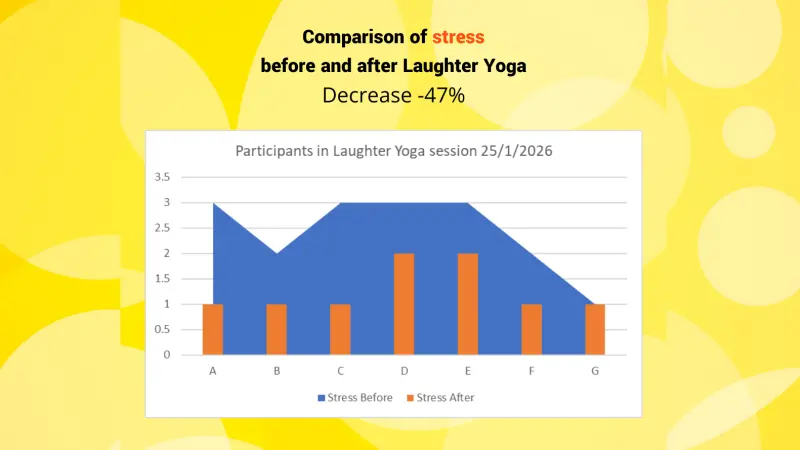
Cortisol levels before and after Laughter Yoga – from Sunny Turner’s own research, Serious Laughter.
So, How Does Laughter Help?
Laughter Yoga uses simulated laughter exercises combined with yogic deep breathing. Participants do not need to be in the mood, and there are no jokes or comedy routines – the body responds to the physical act of laughing regardless of whether it feels genuine at first. That makes it practical, accessible, and easy to bring into a workplace setting.

Here is what happens in the body when your team laughs together:
- The parasympathetic nervous system is activated – this is the rest-and-digest counterpart to fight-or-flight, and it signals safety and calm to the body.
- Cortisol levels reduce, and endorphins – the body’s natural feel-good chemicals – are released.
- Blood pressure rises during laughing (then drops afterwards), and the cardiovascular system benefits from the increased circulation.
- The muscles in the face, chest, and abdomen contract and release, providing a kind of physical release for held tension.
- Oxygen intake increases, which supports both physical and mental energy.
A single session can produce a noticeable shift in how a team feels – and in the room’s energy. With regular practice, the effects build, and the nervous system gradually learns that it is safer to rest than to remain on alert. That is not a soft benefit. That is a measurable reduction in the physiological cost of work.
This Is Not About Putting a Smile on It
Laughter Yoga is not about telling your employees to cheer up. It is not about plastering positivity over a genuinely difficult workplace culture.
I came to Laughter Yoga through my own experience of depression. I understand – firsthand – what it is to feel that your body has turned against you, and to be deeply sceptical of anything that seems too simple or too cheerful.
What I found, and what I have seen in over 13,000 participants since 2017, is that laughter creates a small but significant window of physiological relief. Not a solution in itself, but a genuine reset – a moment in which the body is reminded that it can feel different. For teams under sustained pressure, that matters more than many organisations realise.
What This Means for Your Organisation
If you are responsible for a team’s well-being, the science here is worth taking seriously. The physical effects of chronic workplace stress are not just an HR concern – they affect productivity, retention, sickness absence, and the long-term health of your people.
Serious Laughter offers Laughter Yoga sessions for corporate teams across the UK, both in person and online. Sessions start from £267 for 30 minutes (correct at 1 April 2026) and can be delivered as a one-off taster, a regular team session, or as part of a wider wellbeing programme. Every corporate booking also funds free community spaces, so your investment reaches beyond your own team.
Every corporate booking also funds free community spaces and discounted or free charity sessions, so your investment reaches beyond your own team.
If you’d like to explore what a session could look like for your organisation, I’d be glad to have a conversation. Drop me a line at happy@seriouslaughter.co.uk or visit seriouslaughter.co.uk.
Your team’s bodies are working hard. They deserve a little laughter to release the stress.
References:
1. The 90% statistic American Institute of Stress Website: www.stress.org
2. Immune system / natural killer cells / immunoglobulin A Berk LS et al. Loma Linda University Modulation of neuroimmune parameters during the eustress of humour-associated mirthful laughter. Alternative Therapies in Health and Medicine, 2001 https://pubmed.ncbi.nlm.nih.gov/11253418/
3. Laughter Yoga and cortisol / endocrine stress response Dunbar RI et al. (2020) Laughter and stress relief PubMed PMID: 32393092 Direct link: https://pubmed.ncbi.nlm.nih.gov/32393092/

Sign Up
Receive wellness tips & uplifting videos from Serious Laughter.