Laughter Yoga for Primary Schools: 8 Myths That Might Be Holding You Back

By Sunny Turner
Laughter Yoga for Primary Schools: 8 Myths That Might Be Holding You Back
Summary: If you teach or lead in a primary school, you’re holding a lot – young children’s big feelings, rising anxiety, and your own stretched wellbeing all at once. Laughter Yoga for primary schools is one of the simplest, cheapest tools available to help with all three, yet a few myths keep it out of classrooms that would love it. This article busts eight of the most common ones, from “there’s no time” to “it’ll send them wild,” and shows how a minute or two of laughter can support behaviour, focus, and emotional wellbeing with no equipment and no special training.
The wellbeing picture for young children is worrying more of us every year. More little ones are arriving at school anxious, dysregulated, or simply carrying more than a small person should have to. And primary staff are holding all of it, often while running on empty themselves.
So when I suggest Laughter Yoga for a primary setting, I understand the flicker of doubt. A busy teacher picturing thirty over-excited five-year-olds and thinking, “the last thing this class needs is encouragement to be louder.” I get it – I came to Laughter Yoga through my own experience with depression, and I was a sceptic first. This is why I love sharing laughter exercises to see the difference before and after.
Most of the hesitation I meet in primary schools comes down to a handful of myths. Let’s clear them up.
Myth 1: “There’s no time for this in the school day”
This is the first thing nearly every primary teacher says, and with good reason. The day is packed from the moment they come in.
Here’s the reassuring bit: Laughter Yoga doesn’t need its own slot. A single exercise takes a minute or two. It works as a gentle start on the carpet in the morning, a reset after playtime when everyone comes in fizzing, a wiggle-out before sitting down to write, or a calm-down before home time. You’re not adding to the timetable; you’re using a tool inside the minutes you already have.
Most teachers find it buys back time because a settled, focused class is far quicker to teach.
Myth 2: “It’ll send them completely wild”
This is the big one for primary. Won’t inviting laughter tip an already-bouncy class into total chaos?
In practice, it’s the reverse. The exercises are structured, with a clear start and finish, and they’re always paired with deep breathing. That breathing is the magic ingredient: it switches on the body’s natural calming system, so children come down settled rather than wound up. The usual shape is a short burst of giggles followed by a lovely pool of calm – exactly what you want before carpet time or independent work.
Rather than losing the room, most teachers gain a reliable way to bring the energy back down.
Myth 3: “Little ones won’t take it seriously or follow it”
There’s a worry that young children will either not understand the exercises or descend into silliness.
Here’s the happy truth: primary-aged children are the very best at this. They haven’t yet learned to feel self-conscious about play, so they dive straight in. The exercises are simple, imaginative, and physical – think greeting laughter, animal sounds, or blowing an imaginary balloon – which is exactly how young children love to learn. You’re not asking them to grasp a concept; you’re inviting them to do something they’re already brilliant at.
If anything, the children take to it faster than the grown-ups do.
Myth 4: “It needs special training or equipment”
Some staff assume this is a specialist intervention that requires a kit, a trained facilitator, or a particular space.
It needs none of those. No equipment, no apps, no mats, no special room. Once a teacher has seen how the exercises work, they can lead them themselves, in the classroom, the hall, or out in the playground. This is a tool you can own and use every day, not one that depends on booking someone in. If you’d like some ready-to-use ideas, here are five simple laughter exercises to try in your classroom – no training or equipment needed.
A facilitated session or a bit of staff training is a lovely way to introduce it and build confidence, but the everyday practice costs nothing and needs no qualification.
Myth 5: “It’s not a serious wellbeing tool”
Because it looks like play, it’s easy to file Laughter Yoga under “nice bit of fun” rather than genuine wellbeing provision.
The playfulness is deliberate, but the effects are well-evidenced. Laughter lowers stress hormones like cortisol, releases endorphins, and supports mood and focus. A 2025 systematic review in BMC Pediatrics, drawing together studies with children, found that Laughter Yoga reduced anxiety and stress levels in young people. A separate study in kindergarten children found it significantly reduced separation anxiety – the very thing so many little ones struggle with at the classroom door. For young children, that means a calmer nervous system, smoother transitions, and a warmer classroom climate – the foundations that make learning possible. It sits happily alongside your existing PSHE and wellbeing work rather than competing with it.
Serious wellbeing doesn’t have to look serious to be doing serious work – and with little ones, play is the work.
Myth 6: “It only suits the confident, outgoing children”
There’s a worry that shy, anxious, or younger children will be left out, or that it only works for the naturally bubbly ones.
In fact, the structure tends to draw in exactly the children who usually hang back. Because everyone does it together and nobody performs alone, there’s no spotlight and no pressure. Anxious children often find it a relief, because it gives them something clear and shared to do. And it adapts easily – it can be done seated, in smaller doses, or more gently for children who need that.
It’s one of the more genuinely inclusive things you can bring into an early years or primary classroom.
Myth 7: “The benefits won’t last past the session”
A fair question: is it just a quick giggle before everyone crashes back down?
The immediate lift is real, but the more valuable effect comes with repetition. Used regularly, even briefly, laughter exercises help children build steadier emotional regulation and resilience over time. Start each morning with a short one, and you begin to shape the feel of the whole classroom, not just the next ten minutes. Like any good habit at this age, the benefit builds quietly in the background.
A daily minute of laughter is a tiny investment with a long tail.
Myth 8: “It’s for the children – not for the staff”
Because we frame it as a children’s activity, teachers often forget they need it just as much.
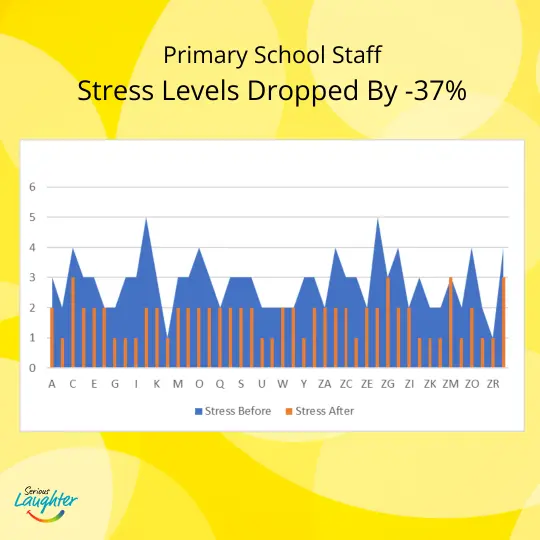
Staff stress and burnout are among the biggest challenges in primary education right now, and the same exercises that settle a class work just as well in the staffroom before the day begins or in a quick reset at lunch. When teachers join in alongside the children, everyone benefits – and little ones take their cue from a calmer, lighter grown-up in the room.
Looking after staff wellbeing isn’t a distraction from the job; it’s what makes the job sustainable.
Frequently asked questions
Do teachers need training to lead Laughter Yoga with young children? No. Once staff have seen how the exercises work, they can lead short sessions up to 10 minutes themselves – you can try five exercises here. A facilitated session or staff training helps build confidence, but the everyday practice needs no qualification.
Will it actually calm the class rather than excite them? Yes, when done as intended. The laughter is always paired with deep breathing, which switches on the body’s calming response, so children typically settle after the initial giggles.
Is it suitable for the youngest children and those with additional needs? Yes. The exercises are simple, imaginative, and easily adapted – they can be done seated, shortened, or made gentler – and the non-competitive, no-performance structure suits a wide range of ages and needs.
How long does an exercise take? Often just a minute or two, so it slots into transitions like coming in from playtime rather than needing its own lesson.
Is there evidence behind it? Yes. A 2025 systematic review in BMC Pediatrics found Laughter Yoga reduced anxiety and stress in children, and a study in kindergarten children found it significantly reduced separation anxiety. More broadly, research links laughter to reduced cortisol, released endorphins, and improved mood, all of which support focus, behaviour, and emotional wellbeing in young children.
Work with the Serious Wellbeing Team
If any of these myths have been holding your school back, I’d love to change your mind. Serious Laughter delivers evidence-based Laughter Yoga sessions for children and teachers, school assemblies, and whole-school training throughout Manchester, Cheshire, North Wales, and across the UK – in person and online.
Whether you’re after a one-off session, staff wellbeing support, or training that lets your team run laughter exercises themselves, I’d be delighted to talk it through. Get in touch at happy@seriouslaughter.co.uk or WhatsApp +44 7974 778091.
Sunny Turner is the founder of Serious Laughter, an FHT-accredited Laughter Yoga Teacher and Museum of Happiness Facilitator. Having come to Laughter Yoga through her own experience with depression, she brings particular empathy to those sceptical of unconventional wellbeing approaches and delivers school wellbeing sessions, wellness workshops, and Laughter Yoga Leader Training across the UK.

Sign Up
Receive wellness tips & uplifting videos from Serious Laughter.