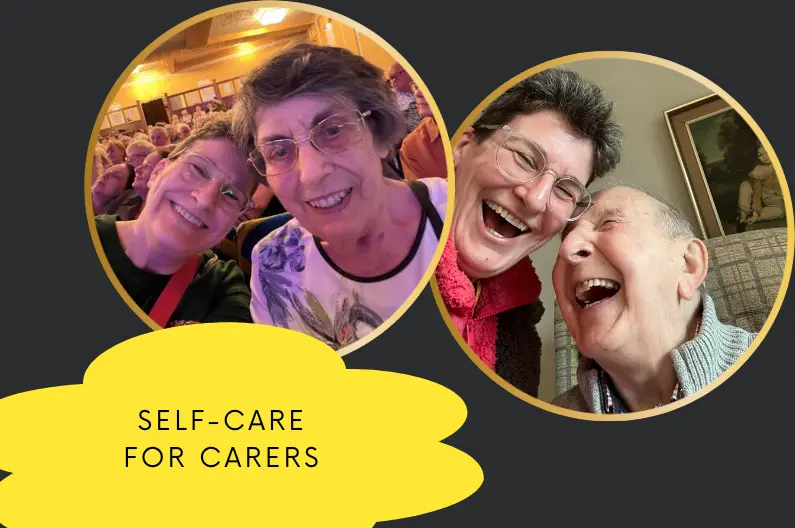
Self-Care for Carers

By Sunny Turner
Self-Care for Carers: A Carers Week Note on Rest, Laughter and Looking After You
Can I ask you something? When did you last do something purely for yourself, not waiting until the to-do list was done, but because you deserved to have some self-care as a carer?
If you had to think hard about that, you’re probably a carer. And I’d love you to keep reading, because self-care for carers isn’t a treat or an extra – it’s the very thing that keeps you going.
Carers Week is here (8 to 14 June 2026), and this year’s theme is “Building Carer Friendly Communities.” It’s a week for noticing the 5.8 million people across the UK looking after a parent, a partner, a friend or a neighbour, and about what that role really takes out of a person. Caring is one of the most loving things you can ever do. It’s also one of the most tiring. Carers UK found that more than half of carers feel overwhelmed often or always, and I don’t think that surprises anyone who’s lived it.
Why carers are always the last name on the list
Maybe you’re an unpaid carer looking after someone you love at home. Maybe you’re a paid carer, moving from one person to the next all day long. Either way, the pattern tends to be the same – everyone else comes first, and you come somewhere right at the bottom, waiting for a quieter moment that somehow never turns up.
Self-care for carers becomes the thing you’ll get to later. After the appointment, or the medication round, or the phone call to the GP, the pharmacy, and the family member who wants an update. And before you know it, “later” has quietly become “never.”
This is what happens when one person carries a load that was always meant to be shared. But it does mean you slowly empty out, often without even noticing it’s happening – and that slow emptying is exactly how carer burnout creeps in. Carers rarely top up their own wellbeing reserves.
carer burnout: constant interruption
Here’s something I really want carers to know, because it gives a name to something so hard to put into words.
There’s been research by Gloria Mark, at the University of California, who found that after just one interruption, it takes us an average of 23 minutes to properly get our focus back. That’s not a couple of minutes – it’s nearly half an hour to gather yourself again.
Now think about your day. The phone rings, then a reminder pings, then your loved one needs a hand getting up or a drink, that’s before all the admin, which pops into your head out of nowhere. Every single one of those tugs you away from whatever little bit of calm you’d managed to find.
So no, it isn’t that you’ve “lost your concentration” or you’re not coping. It’s that your mind barely gets a moment to settle before the next thing arrives. You stay switched on and braced for whatever’s coming. And that quiet, constant readiness is the kind of tired that a good night’s sleep just can’t fix.
Being strong
We tend to talk about resilience as though it means gritting your teeth and pushing through whatever comes. But honestly? That version just grinds people down.
Real resilience is gentler than that. It’s about being able to come back to yourself after the stress, rather than living inside it all the time. And coming back needs a bit of space – a moment where your body can let go, where your mind isn’t being pulled six ways at once, where you’re allowed to just be you for a while, not a service everyone else relies on.
And this is where laughter does something rather wonderful.
Laughter yoga for carers: a few minutes that change the whole day
Here’s the lovely part – you don’t need to feel happy to laugh, and nothing has to be funny at all. Laughter Yoga uses simulated laughter exercises, and your body responds to them just as it would to spontaneous laughter. The magic is that simulated laughter has a habit of turning into the real, can’t-stop-yourself kind. For someone running on empty, even a few minutes can soften your shoulders, settle your system and give your mind a proper break from all the noise.
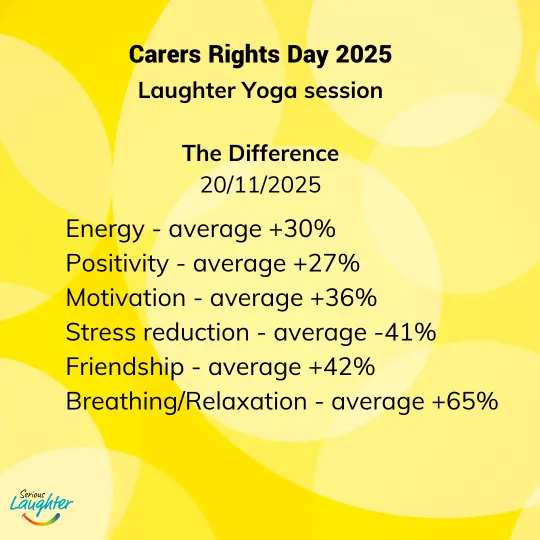
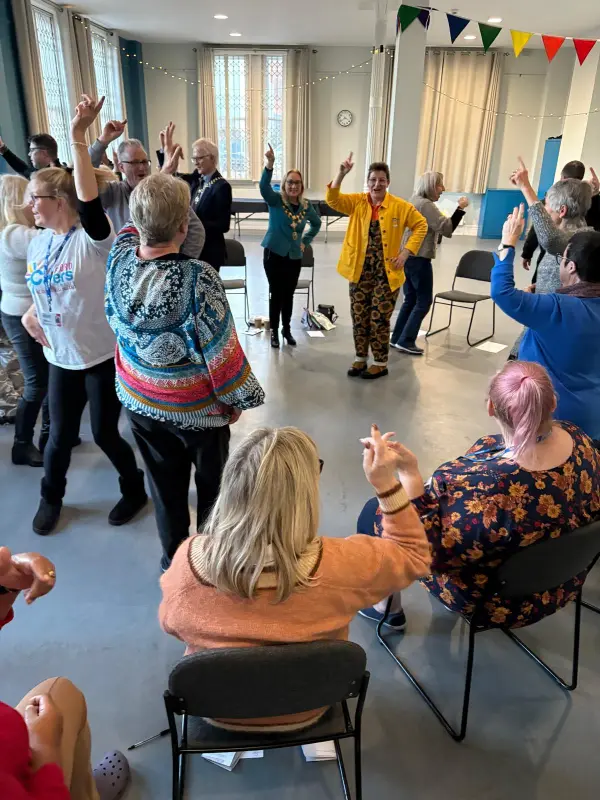
Over the past five years, I’ve run laughter sessions – online and in person – for unpaid carers and for dementia groups. I’ve watched people walk in looking completely worn out and leave lighter, brighter, more themselves again. Laughter won’t make the hard parts of caring disappear. But it gives carers something they so rarely get: permission to receive, instead of always being the one who gives.
If you’d like to try it yourself, here are five simple laughter exercises to get started.
When you’re tired right down to your bones: Yoga Nidra
Sometimes laughter is exactly the thing. And sometimes you’re so deeply tired that what you really need is proper, deep rest.
That’s where Non-Sleep Deep Rest, aka Yoga Nidra, comes in. It’s often called “yogic sleep,” and it really is as restful as it sounds. You lie down, you don’t have to do anything, and you’re gently guided into a deep state of relaxation. You don’t need to be bendy or any good at it – you just rest.
If you’re someone whose mind keeps racing even in the rare moment you get to sit down, this can be a real lifeline. A short practice can leave you feeling like you’ve had hours of sleep. And if your own nights are broken by caring for someone, you’ll know just how much that matters.
Communities that actually look after carers
This year’s Carers Week theme is all about building communities where carers are seen, understood and valued – where support is simply part of everyday life, not something you have to battle for.
I really believe joyful, restful wellbeing belongs in that picture. Laughter sessions, a bit of gentle breathing, some proper rest – these aren’t treats or extras for carers. There are a few things that fill the well back up, so that caring stays something you can keep doing without losing yourself in it.
And it doesn’t all stop in June. Carers Rights Day falls on 19 November 2026, a good reminder that carers deserve not just a kind word but real rights and real support too.
A little time for you, wherever you are
If you’re a carer, when did you last do something just for you?
You don’t have to wait until things settle down or wait for the spare few minutes, because let’s be honest, they rarely do. You matter just as much as the person you’re caring for, if not more!
I run online and face-to-face laughter sessions for carers and community groups across Manchester, Cheshire and right across the UK, so wherever you are, you can join in. My community sessions are always a warm, welcoming space, and there’d be a very happy welcome waiting for you.
Topping your own well-being cup is essential, and prevention is much better than having carer burnout.
Discover what’s coming up in the Events section here. If you’d like to bring a session to your workplace or community group, drop me a line and we can chat about what would work best.
For more information, contact Sunny Turner at happy@seriouslaughter.co.uk or call or WhatsApp +44 7974 778091.
Sunny Turner is the founder of Serious Laughter, an FHT-accredited Laughter Yoga business serving Manchester, Cheshire, London and the wider UK. Having discovered Laughter Yoga during her own experience with depression, she delivers wellness workshops to corporate teams, schools, NHS organisations, and community groups – helping people discover the transformative power of unconditional joy.

Sign Up
Receive wellness tips & uplifting videos from Serious Laughter.