Workplace Stress Management: Causes, Warning Signs and Evidence-Based Solutions

By Sunny Turner
Workplace Stress Management: Causes, Impacts and Evidence-Based Solutions
Workplace stress is one of the most significant health challenges facing UK employees and organisations today. According to Deloitte’s research, stress and mental health-related absences now cost UK employers £51 billion every single year – a figure that reflects not just financial loss, but the very real human cost of chronic stress left unaddressed.
April is Stress Awareness Month, observed annually since 1992, and it serves as an important reminder for organisations to take stock of the stress their people are carrying – and to take meaningful action. But effective workplace stress management is not something that should wait for a dedicated awareness month. The need is year-round, and the solutions are available right now.
In this article, we talk about the key causes of workplace stress, how to recognise the warning signs before they become crises, and the evidence-based strategies – including Laughter Yoga – that are making a measurable difference in workplaces across the UK.
What Causes Workplace Stress?
Workplace stress rarely has a single cause. It tends to build gradually from a combination of organisational, interpersonal, and individual factors – and by the time it becomes visible, it has often already been accumulating for some time.
Organisational Factors
Some of the most common organisational sources of workplace stress include excessive workloads with unrealistic deadlines, poor work design with unclear processes and inadequate resources, inconsistent or unsupportive management, organisational changes such as restructuring or mergers, role ambiguity where responsibilities are unclear or conflicting, and poor communication that leaves employees feeling uninformed or overlooked.
Interpersonal Stressors
The quality of work relationships has a profound effect on stress levels. Conflict with colleagues, bullying or harassment, lack of peer support during difficult periods, workplace discrimination, and the pressures of demanding client or customer interactions all contribute significantly to an individual’s stress load.
Individual and Role Factors
Beyond the broader organisational picture, individual circumstances also play an important role. Feeling powerless over workload or decision-making, job insecurity, limited career development opportunities, blurred boundaries between work and personal life, and an individual’s own history and current life circumstances all shape how stress is experienced and managed.
Understanding the specific sources of stress within your organisation is the essential first step towards addressing them effectively.
How Workplace Stress Manifests: Recognising the Warning Signs
One of the challenges with workplace stress is that its signs can be subtle in the early stages – and by the time they become obvious, significant damage may already have been done to an individual’s health and to team performance.
Physical Warning Signs
Physical symptoms of workplace stress include persistent fatigue and low energy that does not improve with rest, tension headaches and muscular pain, a weakened immune system leading to more frequent illness, sleep disturbances and insomnia, and the development of stress-related conditions such as irritable bowel syndrome or digestive problems.
Psychological Warning Signs
On a psychological level, stress can present as anxiety, worry, and racing thoughts about work, difficulty concentrating or making decisions, feeling overwhelmed and unable to cope, memory problems and mental fog, and a marked decrease in motivation and creativity. These symptoms are often dismissed or minimised – both by the individuals experiencing them and by the organisations responsible for their wellbeing.
Behavioural Warning Signs
Changes in behaviour are often the most visible indicator that someone is struggling. These can include withdrawal from workplace social interactions, increased absenteeism, or presenteeism – where someone is physically present but mentally and emotionally disengaged. Changes in eating patterns, increased reliance on caffeine or alcohol, and a noticeable decline in attention to detail are also common signs.
Managers and team leaders who are trained to recognise these warning signs are far better placed to intervene early and offer appropriate support.
Effective Workplace Stress Management Strategies
There is no single solution to workplace stress – the most effective approaches combine individual support with organisational change, creating a culture in which both prevention and early intervention are actively prioritised.
For Individuals
On a personal level, evidence-based strategies for managing workplace stress include regular mindfulness practices such as meditation and breathing exercises, physical activity including walking meetings and movement breaks during the working day, setting clear boundaries around working hours and technology use, effective time management techniques such as task prioritisation and avoiding multitasking, building supportive workplace relationships, and maintaining consistent self-care routines around sleep, nutrition, and personal time.
For Organisations
At an organisational level, effective stress management requires genuine commitment from leadership. Key steps include ensuring workloads and deadlines are realistic, communicating transparently about changes and expectations, equipping managers with the skills to recognise stress and respond supportively, offering flexible working arrangements where possible, providing clear career development pathways, implementing comprehensive wellbeing programmes, and regularly assessing stress levels through employee surveys and honest feedback mechanisms.
Employees need to feel that their organisation genuinely values their health – and that starts with the actions leadership takes.

Laughter Yoga as an Evidence-Based Workplace Stress Management Solution
Amongst the growing range of wellbeing interventions available to organisations, Laughter Yoga stands out for its speed, accessibility, and scientifically documented effectiveness.
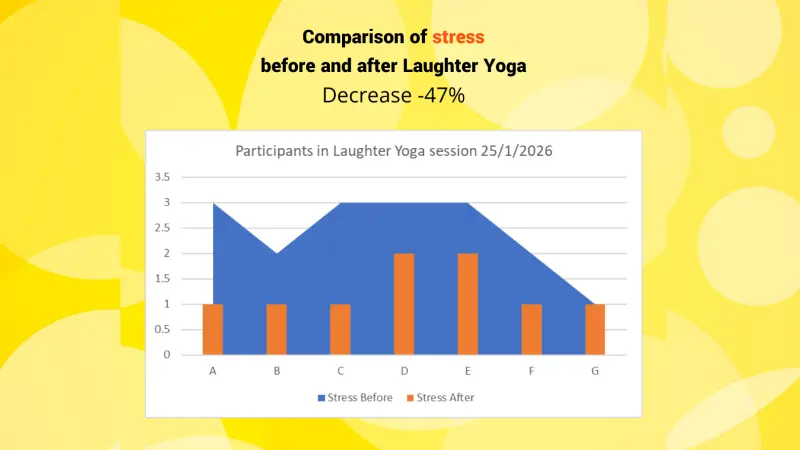
A peer-reviewed randomised controlled trial published in PubMed demonstrated Laughter Yoga’s ability to buffer the body’s endocrine stress response, meaning it actively reduces the physiological impact of stress, not just its perception. In practice, Serious Laughter’s own data shows that on average 40 to 50% of stress is released during a single Laughter Yoga session. Laughter Yoga’s impact on mental health and stress has also been recognised by ITV Granada Reports – read the full feature here.
How Laughter Yoga Works on Stress
Laughter Yoga combines simulated laughter exercises with deep yogic breathing techniques (Pranayama) to create a powerful, dual-action response to stress. Physiologically, it rapidly reduces cortisol – the primary stress hormone – whilst deactivating the sympathetic nervous system’s fight-or-flight response and activating the parasympathetic nervous system, which governs rest and recovery.
The social dimension is equally important. In a group setting, Laughter Yoga builds genuine connection and trust between colleagues – something that is both deeply human and demonstrably protective against stress. Shared laughter releases oxytocin, the bonding hormone, and creates a sense of psychological safety making it easier for teams to communicate openly and support one another.
Importantly, Laughter Yoga does not require participants to feel happy, to be naturally funny, or to have any prior experience. The body cannot distinguish between genuine and intentional laughter – both produce the same positive biochemical response. This makes it accessible to the very people who might need it most: those who are stressed, sceptical, and not naturally inclined towards wellbeing workshops.
Between 40-60% of stress is released through Laughter Yoga. Take a look at the evidence graph below:
What a Serious Laughter Corporate Session Looks Like
Every Serious Laughter corporate session is delivered by Sunny Turner, an FHT-accredited Laughter Yoga Teacher with over nine years of experience. Sessions combine energising laughter exercises, breathing techniques, and – where a 60-minute session is booked – a guided Yoga Nidra (Non-Sleep Deep Rest) practice that leaves participants feeling genuinely restored.
Sessions are available in person across Manchester, Cheshire, Yorkshire, London, and the wider UK, as well as online for hybrid and remote teams. They can be delivered as standalone wellbeing events, conference icebreakers, team-building sessions, or as part of a wider corporate wellbeing programme.
Full details of what happens in a Laughter Yoga session are available on the Serious Laughter website, or you can watch the session video here.
Measuring the Success of Your Stress Management Programme
Once workplace stress management strategies are in place, it is important to track their impact. Useful indicators include reductions in absenteeism and presenteeism rates, improvements in employee engagement scores, decreased staff turnover, enhanced productivity and work quality, positive responses through wellbeing surveys, and stronger team communication and dynamics.
These metrics not only demonstrate return on investment to leadership – they also help identify where further support may be needed and build the organisational case for sustained wellbeing investment.
A Note From Sunny
I understand workplace stress from the inside – not just as a wellbeing practitioner, but as someone who has lived through the kind of sustained pressure that erodes your health quietly, until one day you can no longer ignore it.
What I know, both from personal experience and from nearly a decade of delivering Laughter Yoga in corporate settings, is that people do not need yet another document about stress management. They need something that works – quickly, accessibly, and in a way that actually reaches them where they are.
Laughter Yoga does that. It meets people in the middle of their busy, pressured working lives and gives their nervous system permission to reset. I have watched it happen in boardrooms and community halls, at conferences and on Zoom calls – and the response is always the same. People arrive carrying their stress, and they leave lighter.
If your organisation is ready to do something genuinely effective about workplace stress, I would love to talk.
Transform Your Workplace Stress Management Strategy With Serious Laughter
Employers can make a meaningful dent in the £51 billion annual cost of stress-related absence by investing in evidence-based wellbeing programmes that actually engage employees. Laughter Yoga and Yoga Nidra offer a uniquely powerful combination – accessible, enjoyable, and scientifically proven.
Book a free discovery call with Sunny to discuss how Serious Laughter can support your organisation’s workplace stress management strategy.
Find out the different corporate wellness workshops we offer here. Download the Services Pack.
To receive regular wellbeing tips and uplifting content, join the Serious Laughter newsletter here.
Contact Sunny at happy@seriouslaughter.co.uk or call/WhatsApp 07974 778091
*Research reference: https://pubmed.ncbi.nlm.nih.gov/32393092/ – Scientific study on Laughter Yoga’s effects on stress response
*Additional reference: https://www.deloitte.com/uk/en/about/press-room/poor-mental-health-costs-uk-employers-51-billion-a-year-for-employees.html

Sign Up
Receive wellness tips & uplifting videos from Serious Laughter.