UK Workplace Happiness Statistics 2026: Why Employees Leave

By Sunny Turner
UK Workplace Happiness Statistics 2026: Why Employees Leave
These UK workplace happiness statistics paint a picture every leader should sit with. Your people experience work as a relationship, not a transaction. This data proves it. The Happiness Index has published The Global Workplace Happiness Report 2026, based on over 80,000 working people across 115 countries. The UK workplace happiness statistics tell a striking story.
The big finding? Organisations are investing the most in what matters the least.
The things that really drive happiness and keep people feeling belonging, inspired, and valued get the least attention. The operational things we pour money into, like workload management and role clarity, turn out to matter the least.
For the UK, there’s a warning sign hiding behind some solid scores. Here’s what the 2026 workplace happiness statistics say, and what they mean for keeping your best people.
What the report measures
It’s built on eight neuroscience themes that cover everything from safety and freedom to relationships, recognition, and meaning.
Alongside those, it tracks real business outcomes: productivity, advocacy, and whether people intend to stay. You can connect something like belonging to actual business results, rather than treating wellbeing as a nice-to-have.
The biggest finding: organisations invest in the wrong things
The strongest drivers of happiness at work are inspiration and a sense of belonging. These are emotional things, about how people feel about their organisation and their place in it.
The weakest drivers? The operational stuff that gets the most attention – workload management, role clarity, job requirements.
So the things that matter most get the least investment. And the things we measure and manage carefully matter the least. That single tension runs through the whole report.
UK workplace happiness statistics 2026: how the UK scores
First, a quick word on how the report measures the UK. Rather than only comparing it against the global average of 115 countries, it sets the UK against a peer group of the US and Germany – the three largest advanced Western economies, with similar corporate cultures, big professional-services sectors, and comparable management practices. That gives a fairer, like-for-like benchmark than a worldwide average. Measured that way, the UK workplace happiness statistics show a country doing well in some real areas. Against that peer group, it edges ahead on:
- Happiness
- Relationships
- Clarity
- Productivity
(On productivity, the UK leads its peers but sits just behind the global average, so it’s a relative strength rather than a runaway one.)
It also posts a strong eNPS of +8, well above the peer average of +4. (eNPS, or employee net promoter score, simply measures how likely people are to recommend their workplace to others – a quick read on how proud they are to work there.) So connection and clarity are genuine strengths to build on. (Read what eNPS means in the FAQs below).
But it trails slightly on engagement, acknowledgement, personal growth, and enablement. The relationships are strong. The recognition and growth side is thinner.
The warning sign: UK employee retention
Here’s the one to pay attention to. Of all the UK workplace happiness statistics in the 2026 report, this figure should draw the most attention.
The UK’s “likely to leave” figure is 21.5%. That’s 12.7 percentage points higher than the peer average of 8.8% – by far the biggest gap in the whole UK profile.
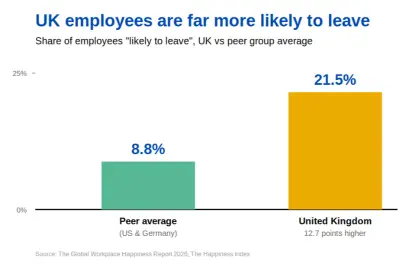
So beneath a respectable score sits a real risk of losing good people. And it’s concentrated in exactly the areas the report says matter most: recognition, growth, and belonging.
The good news: this isn’t failure, it’s opportunity. The UK already has strong relationships to build on.
Why productivity comes from connection, not workload
People feel productive when they enjoy working together and feel kept in the loop. The surprise is that managing your workload – the thing most obviously linked to getting stuff done – is the weakest driver of feeling productive.
In other words, productivity is more about energy than bandwidth. People feel productive when they’re inspired and well-coordinated, not when their to-do list is under control.
Who feels it most
Women score lower than men on 28 of the 29 questions. The gaps are small but consistent, clustering around how valued, free, and inspired people feel. The gap is widest for female executives.
Year five is a trough. New starters score highest on team dynamics and happiness. But by years five to ten, scores drop sharply on how inspired people feel and how connected they are to the organisation. Like many relationships, the honeymoon can run to fatigue.
What leaders can do
The UK workplace happiness statistics point clearly towards connection as the lever that matters most:
- Invest in the emotional side, not just the operational. Belonging and inspiration drive happiness far more than workload audits.
- Build belonging through regular, human moments. Treat people as valued individuals, not resources to be deployed. (For remote and hybrid teams especially, this matters more than ever – see our guide to remote working and loneliness.)
- Watch the year-five trough. Introduce new challenges before mid-tenure, and people quietly switch off.
- Close the recognition gap. Acknowledgement is the weakest area for everyone, and it’s where much of the retention risk lies.
The one Important takeaway
If the UK workplace happiness statistics tell us one thing, it’s that people don’t experience work as a transaction.
What predicts happiness, advocacy, and retention is whether someone sees themselves in their organisation. Do I belong here? Am I inspired? Am I valued? Do I feel listened to?
Think about the relationships in your own life. When they’re strong, they give you energy. When they’re strained, they take it away. Work is no different. For too long, organisations have treated the bond with employees as a swap – salary and benefits for skills and time. The data says that has to change.

Where laughter comes in
Shared laughter is one of the fastest, most human ways to build the very things the report says we’re missing – belonging, inspiration, energy, and that sense of being seen rather than simply managed.
A Laughter Yoga session isn’t about jokes or forced fun. It’s simulated laughter exercises that create a real connection between people, and you don’t need to be happy to start. The connection is the point. And connection is exactly what the data says keeps people, helps them thrive, and makes them champions of where they work.
You can’t put a workflow around belonging. But you can create the conditions for it. That’s the work.
What’s the one relationship-building habit your team already does well, and how could you do more of it?
FAQ
Is the report free to access? Yes. It’s published by The Happiness Index and available to download from their website
What were the strongest and weakest drivers of happiness? Strongest: inspiration and belonging. Weakest: the operational dimensions like workload management and role clarity, which are exactly where many organisations focus.
What does eNPS mean? eNPS stands for employee net promoter score. It measures how likely your employees are to recommend your organisation as a place to work, on a scale from -100 to +100. Anything positive is generally seen as healthy, and the report found it’s driven most by values alignment, inspiration, and belonging.
Why is the UK retention figure a concern? The UK’s “likely to leave” figure of 21.5% is 12.7 points above its peer average. It signals a real risk of losing talent despite otherwise solid scores.
Can laughter sessions really affect retention and belonging? Yes. A shared laugh builds connection, belonging, trust, and energy fast – and those are among the strongest drivers of happiness and advocacy the report identifies. When people feel they belong and enjoy being around their colleagues, they’re far more likely to stay and to speak well of where they work. It’s a simple, human way to invest in the relational side of work that so often gets missed.
Work with the Serious Wellbeing Team
If this report has you thinking about the relational side of your workplace, that’s where we help. We deliver evidence-based, accessible laughter sessions that build belonging, connection, and positive team dynamics – the things the data says matter most.
Find out more about helping you with corporate wellbeing events with Serious Laughter: Corporate Wellbeing
Discover the variety of Laughter workshops and how they can help your team
Download the Serious Wellbeing Services pack
Get in touch: happy@seriouslaughter.co.uk | +44 7974 778091
Sunny Turner | Founder, Serious Laughter | FHT-Accredited Laughter Yoga Teacher | Museum of Happiness Facilitator | Comedy on Prescription Certified Facilitator

Sign Up
Receive wellness tips & uplifting videos from Serious Laughter.