
Workplace Loneliness: When Belonging Fails and Your People Quietly Check Out

By Sunny Turner
Workplace Loneliness: When Belonging Fails and Your People Quietly Check Out
Workplace loneliness is rarely about being alone. It’s about the absence of belonging – your people feeling unseen and unsure they matter, even in a full team. The Global Workplace Happiness Report 2026 found that a sense of belonging is one of the strongest drivers of happiness at work, yet it’s closely linked to poor mental health, burnout and disengagement when it’s missing.
Left unattended, it becomes a downward spiral: your people withdraw, slide into quiet quitting, and disengage further, often invisibly, until it surfaces as burnout or a resignation that seems to come from nowhere.
Belonging is the antidote, and it’s built in small, repeated moments of genuine human connection. Shared laughter is one of the fastest ways to create them, which is why Laughter Yoga has become a practical tool for organisations serious about retention and wellbeing.
Some of the most isolated people in your organisation are sitting in meetings all day. Their work gets done. Their camera’s on. And quietly, they’ve started to feel that nobody would really notice if they weren’t there.
That’s the uncomfortable truth about workplace loneliness. It doesn’t look like an empty desk. It looks like a busy, capable person who has slowly stopped feeling that they belong – and because the output keeps coming, it’s the easiest problem in your organisation to miss.
Consider this: in the Global Workplace Happiness Report 2026, more than one in five UK employees – 21.5% – said they were likely to leave, against a peer average of just 8.8%. That gap is the widest in the UK’s whole profile, and it points to good people preparing to walk while the surface still looks calm.
What does loneliness at work actually mean?
We usually picture loneliness as physical isolation – someone with no one around them. In your workplace, it’s often the other way around. It’s one of your people being surrounded by colleagues and still feeling disconnected from them. Connected to every channel and bonded to no one.
The distinction that matters here is between contact and belonging. You can give your people endless contact – meetings, messages, group chats – and still leave their need for belonging completely unmet.
Belonging is the felt sense that you’re accepted, that you’re valued, that these are your people. When that’s present, your team thrives. When it’s missing, all the contact in the world won’t fill the gap.
Why does belonging matter so much?
Belonging isn’t a nice-to-have bolted onto human nature. We’re a social species, and the sense of belonging to a group has always been tied to our safety and survival. When your people feel they belong, they’re more resilient, more engaged, and more willing to contribute ideas and take the small risks that good work depends on.
When belonging fails, the consequences reach well beyond morale – it actively creates poor mental health. Chronic loneliness is linked to higher rates of depression and anxiety, emotional exhaustion, raised blood pressure, weakened immune function and faster cognitive decline. The World Health Organisation now treats loneliness as a global public health priority – not a private misfortune, but a measurable risk to health.
In your organisation, that translates directly into things you care about: engagement, performance, sickness absence and retention. The Global Workplace Happiness Report 2026, drawing on more than 80,000 working people across 115 countries, points to something that should stop any leader in their tracks. When researchers ranked what makes people happy at work, feeling inspired and feeling that you belong came out on top.
The things many organisations track most carefully – how workloads are managed, how clearly roles are defined – came bottom. So the effort goes into the measurable, manageable things, while the emotional heart of why people stay is left largely to chance. Belonging isn’t soft. It’s one of the clearest retention signals you have – and one of the most overlooked.
How does the downward spiral begin?
What makes loneliness in your team so dangerous is that it rarely arrives all at once. It creeps in, one reasonable step at a time.
- One of your people feels slightly on the outside of the group, so they contribute a little less.
- Contributing less, they’re noticed less and included less.
- Included less, they pull back further – they start doing only what the job strictly requires and no more. This is the stage many now call quiet quitting.
- Disengaged, they stop reaching out, and the distance widens until leaving feels like the only option.
That middle stage deserves a closer look, because it’s so often misread. Quiet quitting gets talked about as laziness or a generational attitude problem, but occupational psychologists increasingly see it as something else: a reduction in emotional investment and discretionary effort that tends to follow chronic stress, exhaustion and a lost sense of belonging.
Quiet quitting is frequently a symptom of loneliness, not a character flaw. The person hasn’t stopped caring because they’re difficult. They’ve stopped caring because, somewhere along the spiral, they stopped feeling part of things.
Every individual step feels minor and entirely understandable. But together they form a spiral that turns slowly and quietly, beneath anything a dashboard or engagement survey would reliably catch. By the time it surfaces – in a resignation that seems to come from nowhere, a stretch of sickness absence, or a once-bright employee who’s simply switched off – the spiral has often been turning for months.
That’s why loneliness is so costly to your organisation. It’s reactive by the time you see it. The intervention happens at a crisis point, when it’s expensive and disruptive, rather than early, when a little connection would have changed the course.
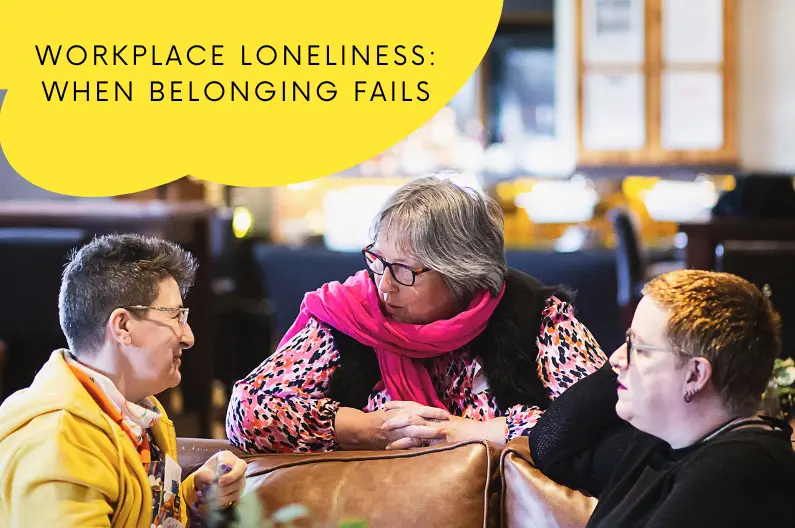
Three people in warm conversation, leaning in and connecting – illustrating belonging and human connection at work

Can the spiral be reversed?
Here’s the hopeful part. Spirals run in both directions. The same momentum that pulls your people apart can pull them back together – if belonging is deliberately rebuilt through small, regular, genuine moments of connection.
Belonging isn’t created by grand gestures or annual away-days alone. It’s created in the everyday: your people being seen, being included, sharing something human with the colleagues they work alongside. Get those small moments right, often enough, and the spiral starts climbing instead of falling. People re-engage. They look out for one another. Your team becomes somewhere people want to stay.
Why is laughter such a powerful way to build belonging?
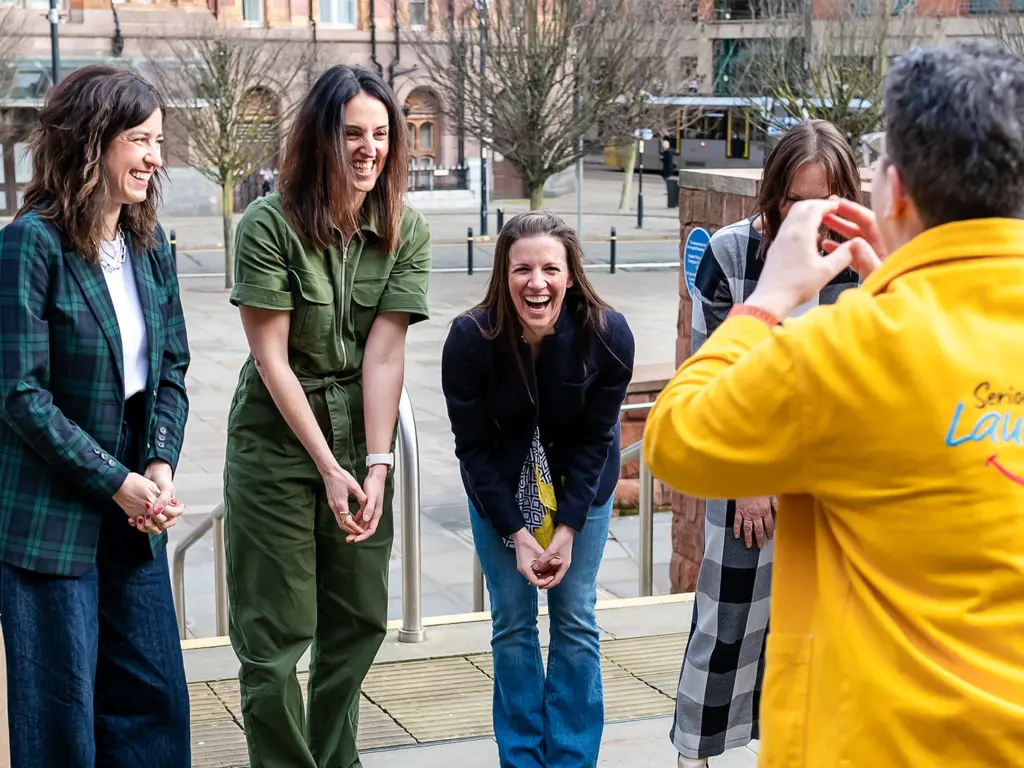
Few things create a sense of belonging as quickly as laughing together. When your team shares laughter, something shifts in the room. The usual barriers drop. Status and seniority matter a little less for a moment. People make eye contact, breathe out, and remember there’s a whole human being on the other side of the email thread.
This is exactly what Laughter Yoga is designed to do. Your people don’t need jokes, comedy or humour – and, crucially, they don’t need to arrive feeling happy. Through simple simulated laughter exercises practised as a group, the body responds much as it would to spontaneous laughter. The simulated quickly becomes real, the room warms, and people who walked in as separate individuals begin to feel like a team again.
For anyone in your organisation who has ever felt invisible at work, that shift – from “I’m on my own here” to “these are my people” – is quietly profound. It’s also accessible to people who struggle with conventional team-building, exercise or talking-based approaches. It asks participants nothing except that they show up.
That accessibility matters. The people in your team most affected by loneliness are often the ones least likely to put themselves forward for a wellbeing initiative. A shared laughter session meets them where they are, lowers the barrier, and rebuilds connection without ever asking anyone to perform or explain themselves.
What can organisations do about it?
Tackling loneliness doesn’t mean adding another item to your already stretched wellbeing budget and hoping it helps. It means being intentional about belonging – building regular, genuine opportunities for your people to connect as humans, not as job titles. A few practical starting points:
- Treat connection as infrastructure, not an extra. Build shared, informal moments into how your teams work, especially for remote and hybrid staff who lose them by default.
- Notice the quiet ones. The person who’s gone a little flat or stopped speaking up in meetings is often the one the spiral has already caught.
- Create shared experiences that level the room. Activities where seniority falls away – and laughter is one of the most reliable – rebuild belonging faster than any memo about culture.
- Make wellbeing genuinely accessible. Choose interventions that the most disconnected people in your organisation can take part in without feeling exposed.
Belonging isn’t a perk. It’s the thing that quietly decides whether your people stay, thrive and look out for each other – or slowly drift away. The good news is that it responds to attention. Start rebuilding those small moments of connection, and the spiral begins to turn the right way.
Frequently asked questions
Isn’t loneliness a personal issue rather than a workplace one?
Loneliness affects health, engagement, absence and retention – all of which are squarely your concern as an employer. You don’t cause all loneliness, but you shape whether your people feel they belong at work, and that has a direct, measurable impact on performance and turnover.
Our team is high-performing. Could they really be lonely?
Yes – and high-performing teams are exactly where it hides best. When output stays strong, disconnection goes unnoticed until someone burns out or leaves. Loneliness at work is about belonging, not productivity, so it can sit beneath excellent results in your team for a long time.
Is quiet quitting linked to loneliness?
Often, yes. Quiet quitting – doing only what the job requires and no more – is usually a sign of disengagement rather than laziness, and disengagement tends to follow chronic stress and a lost sense of belonging. When someone stops feeling part of the team, pulling back their effort is a common, self-protective response. Rebuilding connection is one of the most effective ways to reverse it.
Do people have to be comfortable with laughing to take part in Laughter Yoga?
No. Laughter Yoga uses simulated laughter exercises, so there’s no pressure on your people to find anything funny or to arrive in a good mood. The exercises are designed so that the laughter becomes real on its own – and it works precisely because it asks nothing of participants beyond showing up.
Work with the Serious Wellbeing Team
Whether you’re after a one-off session or a programme that covers several wellbeing pillars, we’d love to talk – every engagement starts with a conversation about what your people actually need. Find out more on our Corporate Wellbeing page. We work across Manchester, Cheshire, North Wales and the wider UK, in person and online.
You can also download our services pack to see the full picture of what we offer, or get in touch at happy@seriouslaughter.co.uk.Sunny Turner | Founder, Serious Laughter | FHT-Accredited Laughter Yoga Teacher | Museum of Happiness Facilitator | Comedy on Prescription Certified Facilitator |

Sign Up
Receive wellness tips & uplifting videos from Serious Laughter.